

 Table of Content
AI visibility is simple to describe and harder to practice. It's about making your AI efforts legible to the entire organization, not just the data team, and letting customers and the market feel the difference. When people can see what's happening, they trust it, use it, and fund the next step.

AI visibility turns quiet experiments into useful digital assets. Once people see what a system does, why it matters, and where its limits sit, it becomes part of everyday decision-making.
The usual problems are less dramatic than a failed model. Goals stay vague. Pilots scatter. Dashboards report activity, not results. A team may produce clever AI content, yet the tool never enters anyone's working day.
The 90-day roadmap below closes that gap, moving week by week from one focused idea to a visible result.
People get time to test the system and decide whether it should grow. That distinction matters because teams often confuse a working demonstration with a reliable system that people can understand, question, and use under pressure.
Understanding Your AI Goals
Having an idea for using AI is not the same as knowing what you want it to achieve. A clear goal gives the project direction and helps everyone understand why it matters. Without one, even an impressive AI tool can become an expensive solution to the wrong problem.
Clarity comes first. Connect one or two business outcomes to measurable targets. Reduce average handle time by 15 percent. Cut stockouts by 10 percent. Lift qualified leads by 20 percent. The team then has a practical standard for progress.
In healthcare settings, Bryan Henry, President of PeterMD, has seen vague ambitions derail more AI programs than bad code ever did
He said, “The teams that succeed with AI define what winning looks like before they write a single line of code. If a goal can't be measured and mapped to a business result, it's a wish, not a strategy. Clear targets also give teams a shared standard for deciding what to prioritize, improve, or stop.”
The goal should support the company's larger priority. For retention, consider churn prediction, proactive service, or personalization. For margin, examine forecasting, scheduling, or dynamic pricing. Compare competing ideas by business value, data readiness, and effort.
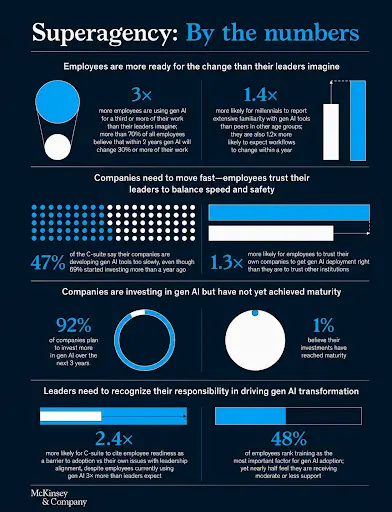
According to McKinsey, 92% of companies plan to increase their generative AI investments, yet only 1% describe their programs as mature. Spending alone does not create maturity. Each project still needs a clear purpose and a measurable result.
The 90-Day AI Visibility Roadmap That Works in 2026
A successful 90-day AI visibility plan works best when each stage builds on the progress made before it. Below are the three phases that turn a focused AI idea into measurable, sustainable results:
Building the foundation: weeks 1–3
In the first three weeks you're setting the table so the meal actually gets served.
Form a cross-functional team that can carry one use case from selection to proof. Projects stall in silos when no group has the knowledge or authority to move them.
Bring engineers, domain experts, users, and an executive sponsor together. Include a product owner, data scientist or machine learning engineer, data or analytics engineer, customer- facing representative, and sponsor who can clear roadblocks. Shared ownership carries the project through difficult tradeoffs.
Next, run an honest AI audit. Do not buy another tool yet.
Map existing data, systems, and skills. Useful capabilities may sit idle while weak local visibility or manual data pulls slow progress. Inventory sources, quality, permissions, analytics tools, model registries, deployment paths, and monitoring.
Record the policies that shape privacy, security, and responsible AI. This is not paperwork around the plan. It is part of the plan.
Grant Thornton’s 2026 AI Impact Survey Report found that 78% of executives are not highly confident their organization could pass an independent AI governance audit within 90 days. Meanwhile, 46% identify weak governance and regulatory controls as a major reason AI initiatives fail to deliver expected results.

Write a one-page strategy naming the flagship use case, metric, owner, timeline, and decision points. Track technical performance such as precision and recall, business lift such as conversion or time saved, and adoption through active users or opt-in rates.
For responsible disclosure, consider model cards documenting intended use, measurements, and limitations. People can then understand the system before trusting it.
Scaling up: weeks 4–8
Now you move. The goal in this middle stretch is to ship a pilot, train people, and get performance visible as soon as results start coming in.
Choose a contained problem with usable data and an engaged owner. A small pilot is easier to observe, correct, and explain than a broad rollout.
At Rise, Deputy Chief Digital Growth Officer Gregor Emmian tests ideas through small pilots before committing to a wider rollout.
He puts it simply: "Pick a contained problem, ship a pilot, and let the results speak. A small, well-documented win earns you the trust and the budget to scale far faster than any pitch deck ever will."
Favor short feedback loops and people who will use the output. Try lead scores for sales, next-best-action suggestions for support, or demand forecasts for replenishment. Put the pilot in a real workflow.
Build skills alongside confidence. Tools do little when employees do not know when to use them. Invest in online training and careful experimentation. Questions and poor results must be safe to report.
Offer brief role-based sessions. Frontline teams use AI suggestions, managers interpret measures, and data teams log experiments. Office hours catch confusion early. Recognizing thoughtful tests shows that learning matters alongside wins.
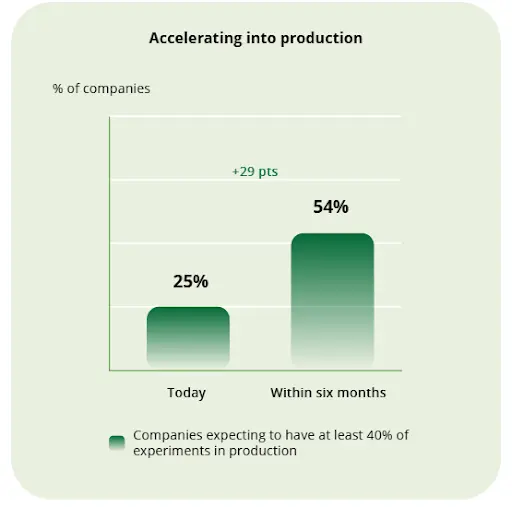
The State of AI in the Enterprise by Deloitte reports that employee access to AI increased by 50% in 2025. Companies with at least 40% of AI projects in production are expected to double within six months. Giving people access, training, and practical support can help turn isolated pilots into tools used across the business.
Make performance visible to the people responsible for it. Useful dashboards reveal changes within days, before small problems become expensive.
A lightweight MLOps stack may be enough. MLflow or Weights & Biases, can track experiments, while Evidently can flag data drift. Power BI or Looker can place model performance beside business outcomes.
A GEO, AEO, and LLMO optimization strategy can ground AI in data and limit outputs to verifiable work. Human review consistently keeps risk manageable. These weeks are about momentum, not perfection.
The point in weeks 4–8 isn't perfection. It's visible, measurable momentum.
Maximizing AI visibility: weeks 9–12
With a working pilot and real numbers, you turn results into advantage, stories, and long-term habits.
Technical improvement matters when someone experiences it. An algorithm becomes valuable when customers receive faster, more relevant service and the change reaches the bottom line.
If the pilot improves lead conversion, place it inside sales. If support becomes faster, share that improvement on a status page or in onboarding emails. Customers need to feel the difference.
- Share the result internally. A clear story helps another team judge whether the approach could work for them. External stories show that experiments become real improvements.
- Create a one-page case with the problem, approach, before-and-after result, and user quote. Brief the executive team. After privacy and compliance review, publish it on the company blog or LinkedIn.
- Prepare for sustainability. Pilots fade without plans for data refreshes, retraining, incidents, or changing goals. A launch is an event. A dependable AI system is an ongoing responsibility.
- Set retraining schedules, performance expectations, incident runbooks, and quarterly reviews. Decide whether each model should be retired, adjusted, or expanded.
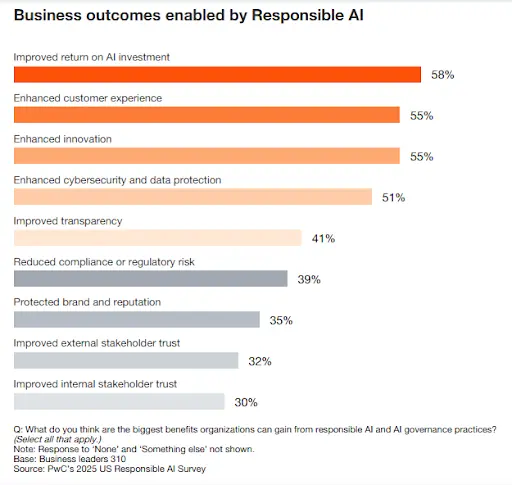
PwC’s 2025 Responsible AI survey found that 58% of organizations report improved ROI and efficiency from responsible AI, while 55% report better customer experience and innovation. Strong oversight can support performance rather than slow it down.
Responsible AI is not a policy slide. It is a checklist people use.
How to Maintain AI Visibility After 90 Days
Maintaining AI visibility requires more than completing a successful pilot. Here are the steps that can help turn early progress into lasting business value:
1. Turn the pilot into a repeatable system
Assign owners, schedule reviews, and document how data, model behavior, and results will be monitored. A repeatable process prevents dependence on one person's memory. Create a routine for maintenance, updates, and problem reporting.
Prabhath Sirisena, Co-founder & CPO of Hiveage, has watched plenty of early AI wins quietly disappear once the excitement fades.
He explained, "A pilot that only lives in one person's head isn't a system, it's a favor waiting to run out. The moment you write down who owns it, when it gets reviewed, and what happens when it breaks, you've turned a good demo into something the business can actually rely on."
2. Keep outcomes visible
Share short updates with affected people. Connect performance to faster service, fewer errors, lower costs, or better decisions. For AI images, report whether they reduce production time or create more review work.
Match visibility to the operation. A custom T-shirt company may track design turnaround and order accuracy, while another business measures call resolution or forecasting error.
3. Choose the next project carefully.
Review results, feedback, and lessons before moving forward. A family law workflow may require different data controls and human review than a low-risk internal assistant.
Scale only when people use the system and evidence supports investment. Then apply the same approach to a valuable problem with usable data and a prepared owner.
Where To Start
Start with one business problem that matters now and can be measured clearly. A focused use case gives your team a better chance of producing visible results within 90 days.
Gather the right people, assess available resources, and define success. A perfect strategy is unnecessary. Ownership, useful data, and a practical goal are not.
The first quarter should produce evidence, not solve everything. If people trust a pilot that improves a real outcome, the organization has a basis for deciding what comes next.