
 Table of Content
Most dental practices miss 30 to 40% of inbound calls. The patient hits voicemail and books down the street. That’s the core problem every tool on this list is trying to fix.
The category moved fast in 2025 and 2026. Several of these companies raised their first round within the last 18 months, which means the market hasn’t settled on pricing norms yet. One thing to know upfront: most vendors don’t publish prices.
You’ll get a custom quote after a demo call, and that number shifts based on call volume, how many locations you run, and which integrations you need. Patientdesk is the one exception - they publish a starting rate, which stands out in a space where everyone else keeps you in the dark until they’ve got you in a sales conversation.
Before You Pick One
Eight of these tools - Dentina, Rondah, HeyGent, Patientdesk, HiClinic, Voicelabs, VoAgents, and DentalAssist - are doing the same basic job: answer inbound calls, book appointments, and sync back to your practice management system.
The differences are in how deep the integration goes, whether they handle outbound follow-up, and whether insurance verification is included or an add-on. If you’re still evaluating whether appointment scheduling software fits your workflow at all, that’s worth working out before you get on a single demo call.
Denti.AI is wider than just the phone. It bundles reception with clinical charting and imaging diagnostics - the receptionist feature is one of three modules. RoboReception covers multiple healthcare verticals including dental, rather than being dental-first.
Pricing in this category runs roughly $200 to $800 per month for single locations. That’s a wide range, and call volume is what determines where you land.
At a Glance
Tool | Pricing | Free Trial | Best For |
|---|---|---|---|
Dentina.AI | Custom | Demo only | Dentist-designed PMS write-back |
Rondah AI | Custom | Demo only | DSOs and multi-location groups |
Denti.AI | Custom | Demo only | Reception and clinical tools in one |
HeyGent AI | ~$800/mo | Demo only | Voice plus text-based patient follow-up |
Patientdesk.ai | From $550/mo | Demo only | Transparent flat-rate pricing |
HiClinic | Custom | Demo only | Voice workflows for dentistry |
Voicelabs Dental | Custom | Demo only | Dental-specific voice handling |
RoboReception AI | Custom | Demo only | Multi-specialty healthcare groups |
VoAgents | Custom | Demo only | Patient recall and outbound scheduling |
DentalAssist.ai | Custom | Demo only | Full front-desk call coverage |
1. Dentina.AI

Built by a dentist, which shows in how it handles intake. It manages inbound and outbound calls, covers after-hours and overflow, and writes results back to your PMS in real time without a manual sync step. Integrations include OpenDental, Dentrix, and Eaglesoft - which covers most US single-location practices.
Pricing needs a quote. Third-party comparisons say Dentina is one of the few vendors that gives you an exact number once you start talking instead of making the process take longer than it should.
What It Does: Handling outgoing calls coverage during after-hours and when there`s a lot of calls setting up appointments updating PMS in real time working with multiple PMS systems.
Best For: Practices that want a tool built for dental work from the start, not a regular phone service that just has a dentistry tag on it.
2. Rondah AI

Rondah’s clearest differentiator is deployment scale. The company reported over one million patient conversations per month as of April 2025, which suggests real usage depth rather than a polished demo.
It’s built with DSOs and multi-location groups in mind - the pricing model and sales process both reflect that. For a single-location practice, you’re likely paying for infrastructure you won’t fully use. For a group running five or more locations, it’s the right conversation to have.
What It Does: 24/7 communication, appointment scheduling, front-office automation multi-location support DSO-scale workflows.
Best For: Groups and DSOs that need consistent front-desk coverage across multiple sites without growing the headcount at each one.
3. Denti.AI

Denti.AI is three tools: Voice (the receptionist), Auto-Chart (clinical documentation), and Detect (FDA-cleared pathology detection in imaging). If you only want phone coverage, the platform may be more than you need.
If you’re eventually looking to automate clinical documentation alongside front-desk calls, the bundled pricing makes a real difference.
What It Does: Call handling (24/7), appointment booking, automated clinical charting, pathology detection on X-rays, multi-PMS integration
Best For: Practices that want to handle front-desk and clinical workflow tools from one vendor, instead of separate subscriptions.
4. HeyGent AI

HeyGent handles both voice and text from the same system - missed calls, web chat, and marketing lead follow-up all land in one place. It’s founded by dentists, which matters for how it categorizes conversations.
The emergency care detection feature is worth noting: it reads a patient message and sends a notification if it picks up signs of an urgent situation. Billing is minute-based, roughly 200–800 per month depending on volume.
There’s a daily and monthly minute cap you can set, so costs don’t quietly grow with a busy month.
What It Does: Follow-up of missed calls for voice calls, SMS and web chat, appointment booking, emergency detection, patient reactivation, voicemail transcription.
Best For: High-volume offices and multi-location practices that want text and voice patient engagement handled in one place.
5. Patientdesk.ai

The only tool on this list with a published starting price: $550/month for 1,500 minutes, overages at $0.20 per minute. That level of transparency is rare here. It’s a Y Combinator Winter 2026 company, so it’s early but moving fast.
Beyond scheduling, it handles insurance verification in real time during a call and runs outbound payment reminder calls - tasks that typically require a staff member tracking them down manually. Setup fees are listed as refundable.
What It Does: Inbound call handling, appointment booking, real-time insurance verification, payment reminders, outbound patient campaigns, PMS write-back.
Best For: Practices that want to know what they’re paying before the first demo call, plus practices where insurance and collections tasks eat into staff time.
6. HiClinic

HiClinic covers dental within a healthcare-focused voice platform. The dental module handles call routing, appointment booking, and patient communication without requiring staff to field routine calls themselves.
It’s built to plug into existing phone infrastructure rather than asking you to replace how your phones work. Pricing is custom through their sales team.
What It Does: Voice call handling, appointment scheduling, patient inquiry routing, PMS integration, call routing.
Best For: Practices that want a voice phone tool that sits on top of existing infrastructure without a full platform changeover.
7. Voicelabs Dental

Voicelabs is Dutch, and its receptionist, Eva, comes in two versions. Eva Lite just answers calls day and night. Eva Connect goes further and books straight into your practice software.
It can take seven calls at once, and the company leans on GDPR compliance, which is great in Europe and beside the point in Ohio. A US practice should ask about HIPAA terms before anything else. Pricing depends on your setup and call volume.
What It Does: Inbound and outbound voice calls, appointment booking, patient reminders, after-hours coverage, dental-trained call handling.
Best For: Practices that want a voice tool that understands context natively rather, than needing extensive setup to get there.
8. RoboReception AI

RoboReception covers multiple healthcare verticals, dental included. That’s both its appeal and its limitation. If your practice is part of a group running dental alongside other specialties, one front-desk tool across all of them has real operational value.
If you’re a standalone dental practice, you’ll get less built-in dental specificity compared to tools designed only for this context. Pricing is custom.
What It Does: 24/7 call answering, appointment scheduling, patient inquiries, multi-specialty coverage.
Best For: Healthcare groups that run dental alongside other practice types and want one phone system across the board.
9. VoAgents

VoAgents’ dental offering focuses on scheduling, patient recall, and outbound follow-up for lapsed patients.
The positioning is around practices with appointment gaps or recurring no-shows - it handles the follow-up calls that usually fall to whoever has a free minute between patients. PMS sync keeps the schedule current. Pricing is custom and requires a demo.
What It Does: Inbound scheduling, patient recall, outbound follow-up calls, appointment reminders, PMS sync.
Best For: Practices with a high volume of lapsed or inactive patients who want outbound recall handled without adding front-desk staff.
10. DentalAssist.ai
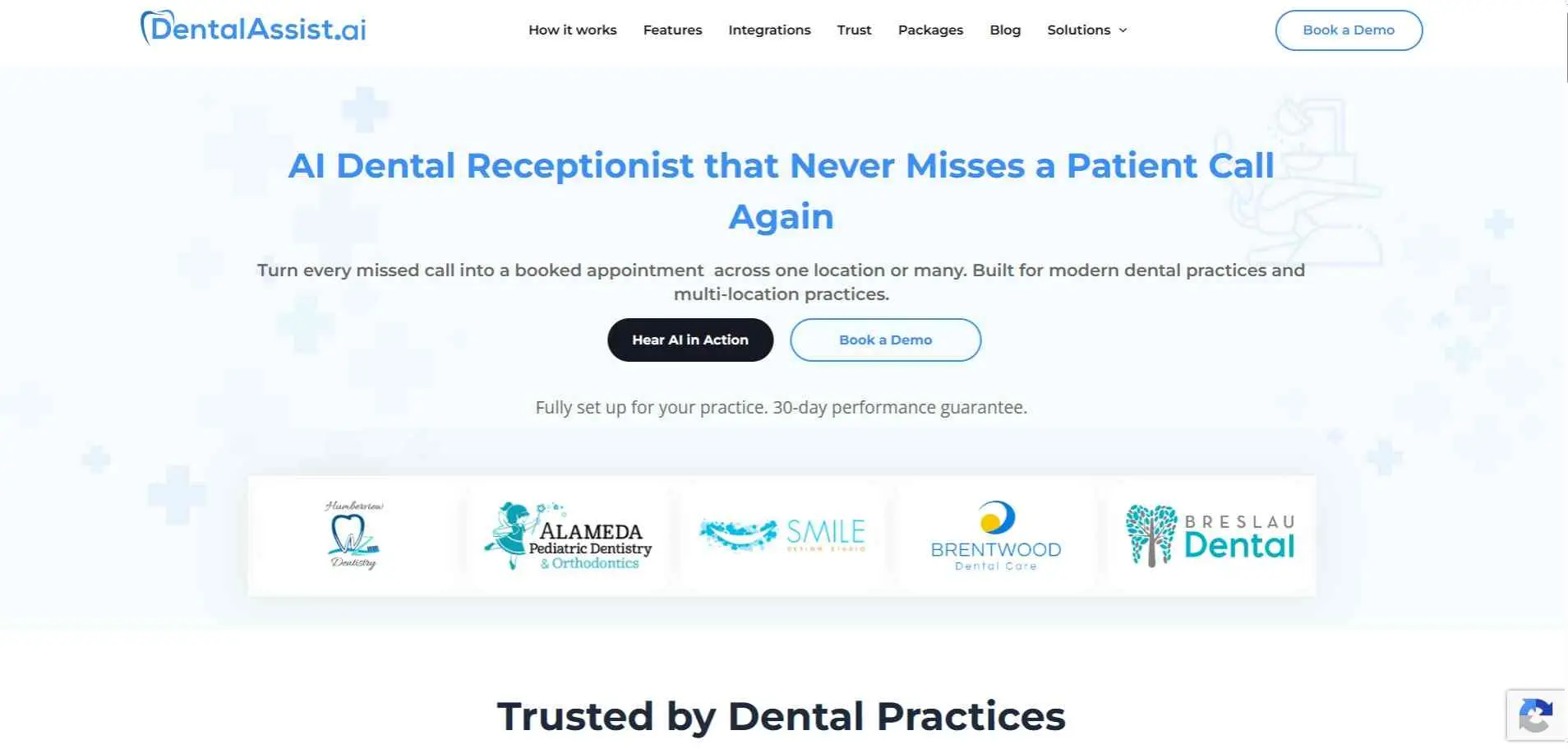
DentalAssist covers standard front-desk scope: inbound calls, appointment booking, patient FAQs, insurance questions, and follow-up communications.
It’s positioned as broad front-desk coverage rather than a specialist tool - which fits practices looking for coverage across all routine patient touchpoints. Pricing is custom.
What It Does: Inbound call handling, appointment booking, patient FAQs, insurance inquiries, follow-up communications.
Best For: Practices that want one tool covering every standard patient communication task without a narrow specialty focus.
Which One Fits Your Practice
Start with location count. Rondah is designed for groups. Most of the others work for single locations and small groups, but weren’t built with DSO scale in mind.
If you want a published price before you get on any sales calls, Patientdesk is the only real answer. $550/month with a clear per-minute overage rate. Everyone else requires a demo first.
If you want phone and clinical workflows from one vendor, Denti.AI is the one to look at. The other nine are phone-focused. For practices with a lot of inactive patients or no-show problems, HeyGent and VoAgents both handle outbound follow-up more explicitly than the rest of the list.
If your phones work fine and you just need coverage layered on top, HiClinic and Voicelabs Dental are worth comparing - both are dental-specific and don’t ask you to rewire your existing setup.
Bottom Line
Many of these tools are solving the core problem. The differences that actually matter are the depth of integration whether the tools handle insurance and collections with booking and whether the tools were built specifically for dentistry or were adapted from something broader.
Monthly price is almost never the useful number. Call volume is. Work out how many inbound calls your practice takes weekly before comparing quotes - that’s where the real cost difference between a flat rate and a minute-based model becomes clear.
A broader look at appointment scheduling essentials can also help you frame what you actually need before you start a demo process.