
 Table of Content
Ask ten scrapers which proxy provider is best and you’ll get ten different answers. They’re scraping ten different things. Someone pulling Amazon prices every hour has little in common with someone crawling a government site once, and neither needs what an ad-verification team needs.
One thing to know before the list. Not every name here sells proxies in the usual sense. ScrapingAnt, Scrapfly and Scrapingdog sell scraping APIs that handle proxies for you, and Decodo and Bright Data sell both. This isn’t a ranked countdown. Each entry says what the tool does well and where it falls short, and every price comes from the provider’s own site, checked in November 2026.
Proxy Networks Versus Scraping APIs
Proxy networks (Roundproxies, Webshare, DataImpulse, IPRoyal, SOAX) hand you IP addresses. Your own code handles browsers, retries and parsing. Scraping APIs like ScrapingAnt, Scrapfly and Scrapingdog work simply: you send a URL, you get the page back. The proxies are hidden behind the call. Proxy networks differ too. Rotating residential IPs change on every request, while ISP and datacenter IPs stay put.
The difference shows up in pricing. Networks charge per gigabyte or per IP. APIs charge per credit, and one request can cost between 1 and 25 credits depending on what it needs. A $1 per GB rate and a $19 credit plan can’t be compared until you know your page weight and how often you get blocked. Separately, check each site’s terms and the law where you operate before you scrape.
1. Roundproxies
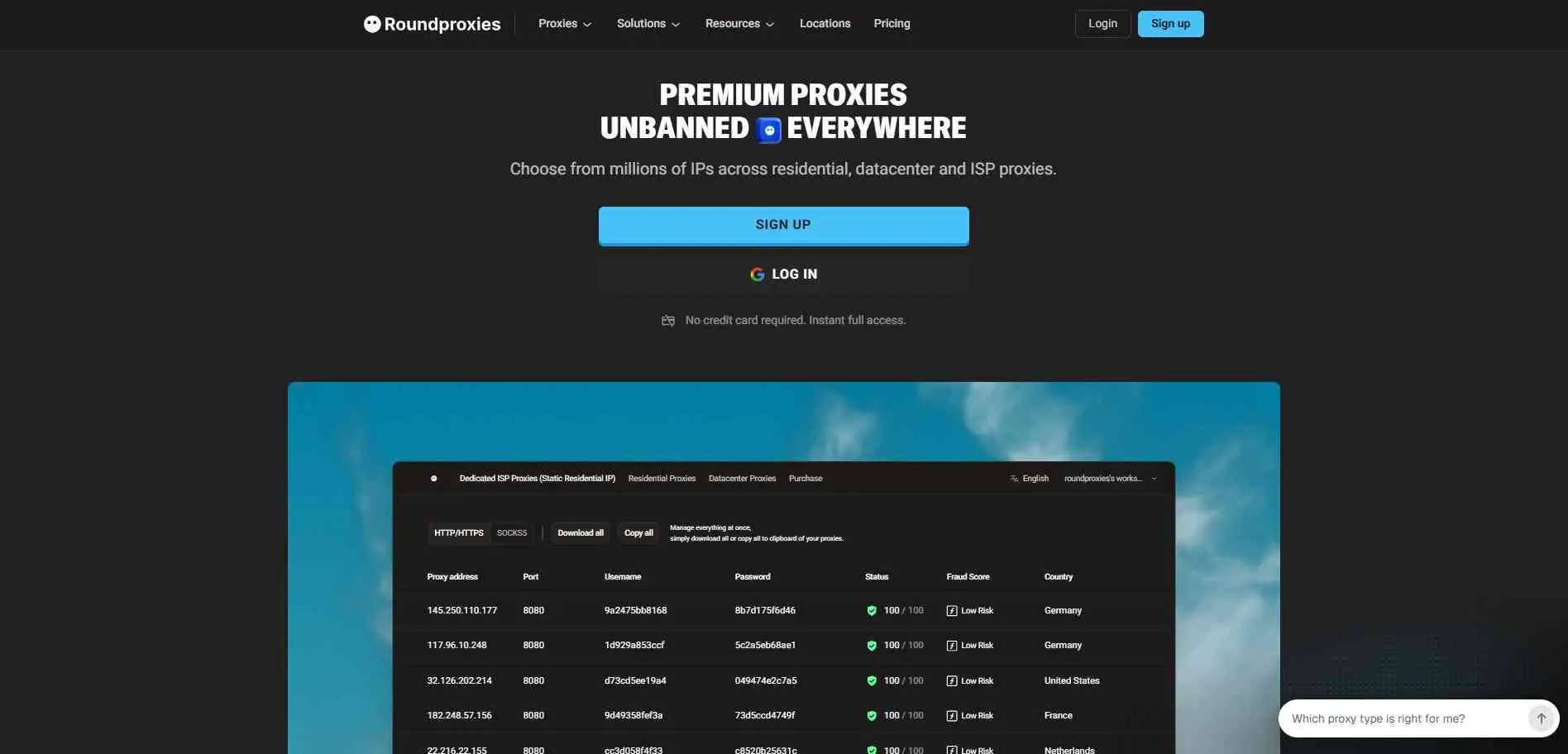
Roundproxies is run by Roundlabs, LLC and sells residential, ISP, datacenter and mobile proxies from one dashboard. Signup needs no credit card. This service also gives tools such as a proxy checker, an IP lookup and a free proxy list.
The service runs a Discord community, writes scraping guides for Google, YouTube and TikTok. The service competes on the range of services and low friction than the platform features.
Key features
- Residential proxies with city targeting in 195 countries and unlimited concurrent sessions
- A dashboard that lists each proxy with a status and fraud score, plus bulk copy and download
- Datacenter and high-bandwidth plans for cheap bulk jobs
Best for
Small teams that want to try several proxy types quickly before committing.
2. Decodo
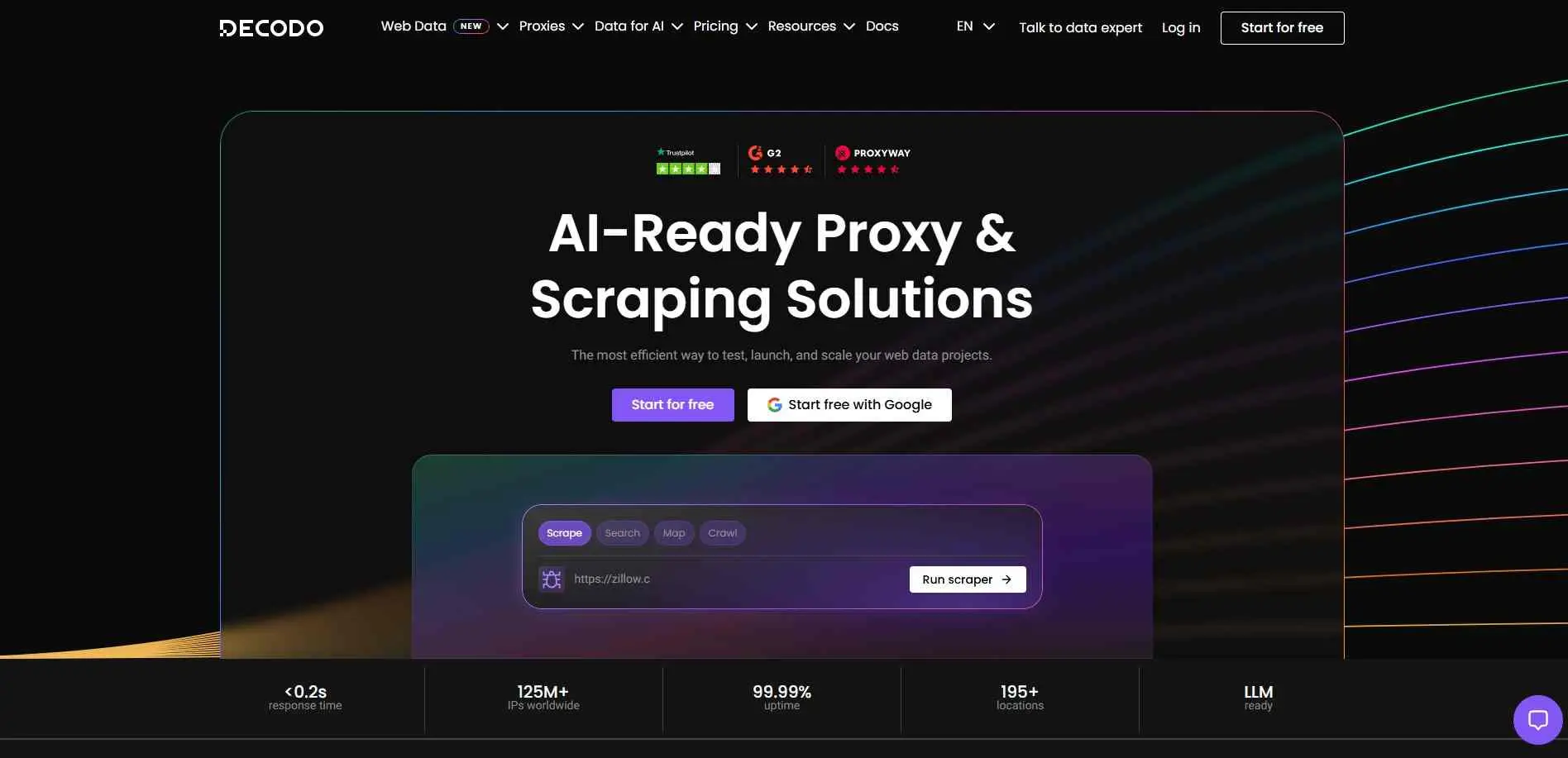
Decodo is the new brand name for since April 2025, with the same team and network. The company is in Vilnius, Lithuania, has sold proxies since 2018, and says it has 135,000+ clients. It now sells a scraping API as well, which makes it the easiest step up if your project outgrows plain proxies. Its own site also warns that smartproxy.org is an impersonator. The only official domain is decodo.com.
Key features
- Residential proxies from $2/GB, datacenter from $0.02 per IP, mobile from $2.25/GB
- A Web Data API with scrape, search, map and crawl endpoints, from $0.15 per 1,000 requests
- An official MCP server plus Python, TypeScript and Go SDKs for AI agent work
Best for
Developers who want proxies today and an API later without changing vendors. It offers a 3-day proxy trial and a free API tier of 10,000 requests.
3. Webshare
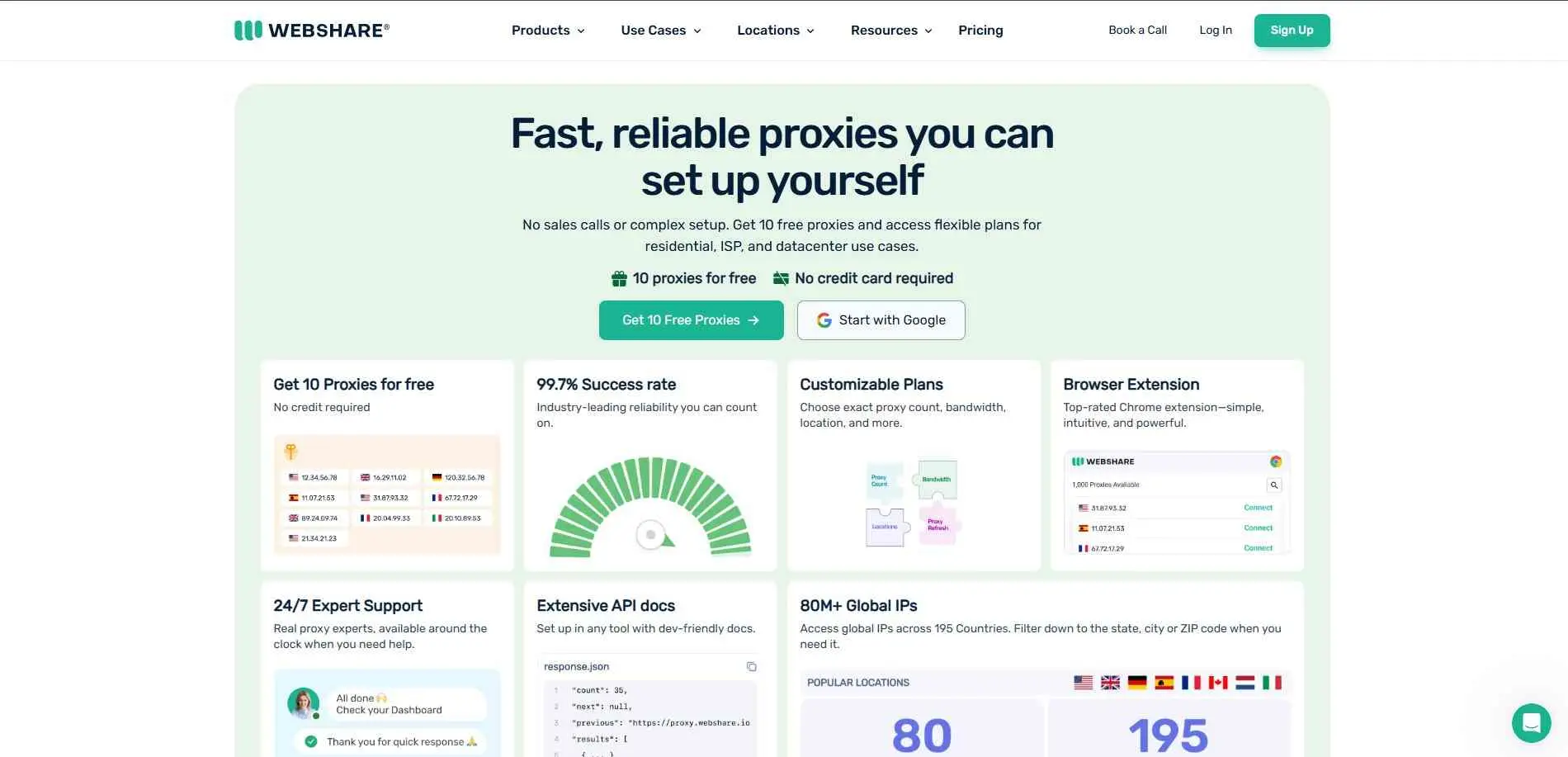
Webshare is the low-barrier option, run by a team it places in Silicon Valley. It says it has 90,000+ paying customers and handles 650 billion proxy requests a month. Every account gets a permanent free plan of 10 proxies, and paid plans let you set proxy count, bandwidth and location yourself. It also claims a 99.7% success rate, a number worth testing on your own targets.
Key features
- Entry plans from $2.99/month for datacenter and $3.50/month for rotating residential
- 80M+ residential IPs with state, city and ZIP filtering
- A full API, a Chrome extension and 24/7 expert support
Best for
Freelancers, students and side projects. The listed prices are entry-level, so check how much bandwidth they include.
4. DataImpulse
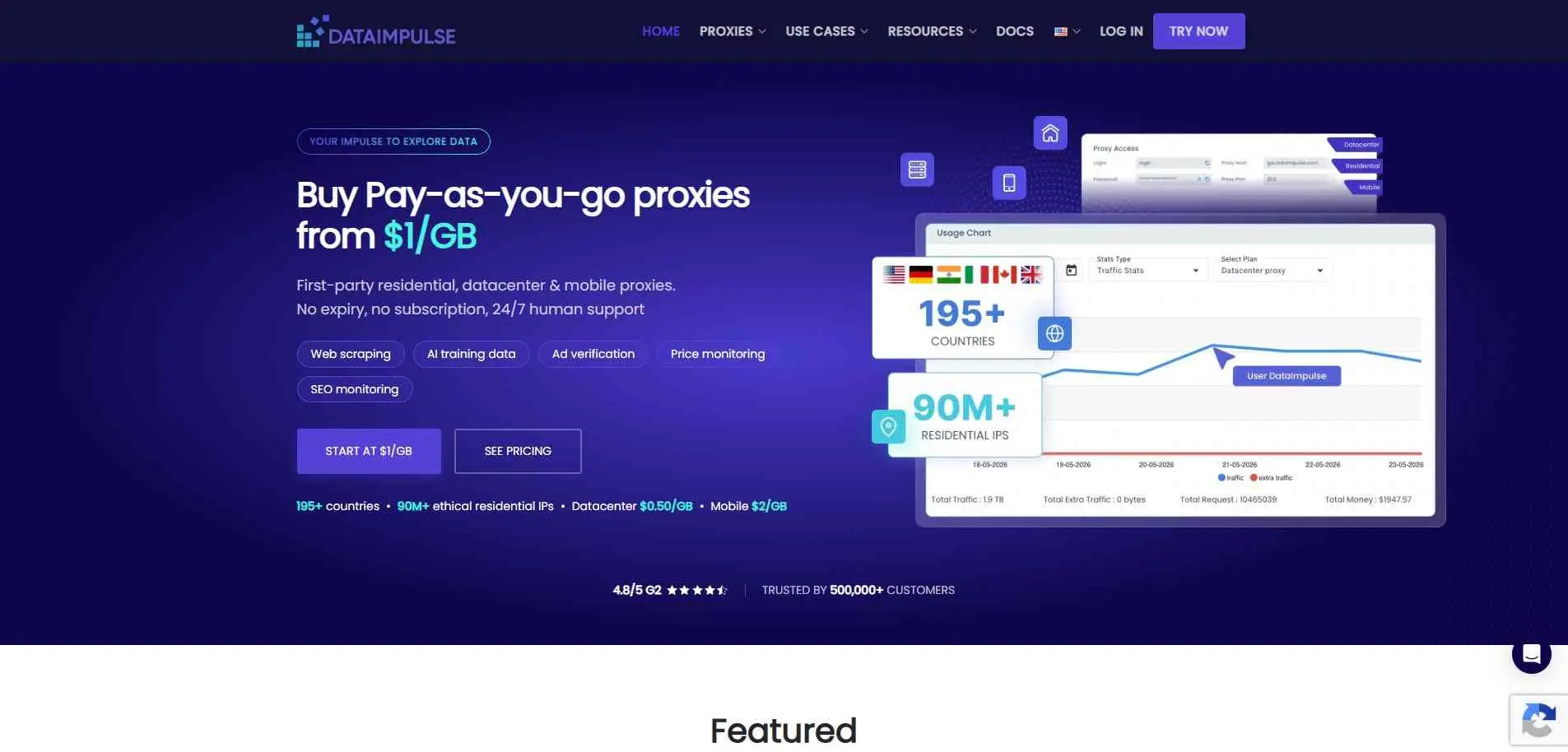
DataImpulse says it has spent four years in the proxy business and now serves 500,000 plus customers. DataImpulse sells traffic by the gigabyte with no subscription and no expiry date, which suits work that comes in bursts. It lists an ISO 27001 certificate and two industry awards, Greatest Progress and Most Flexible Provider. DataImpulse says its residential IPs are first‑ parties then resold a claim you can only test by running traffic.
Key features
- Residential at $1/GB, datacenter at $0.50/GB, mobile at $2/GB, with a $5 intro top-up
- 90M+ residential IPs, free country targeting, and extra-fee city, state, ZIP and ASN targeting
- Sticky sessions up to 120 minutes on residential
Best for
Irregular workloads where a monthly plan would sit unused. Buying 1TB at once brings residential down to $0.80/GB.
5. IPRoyal
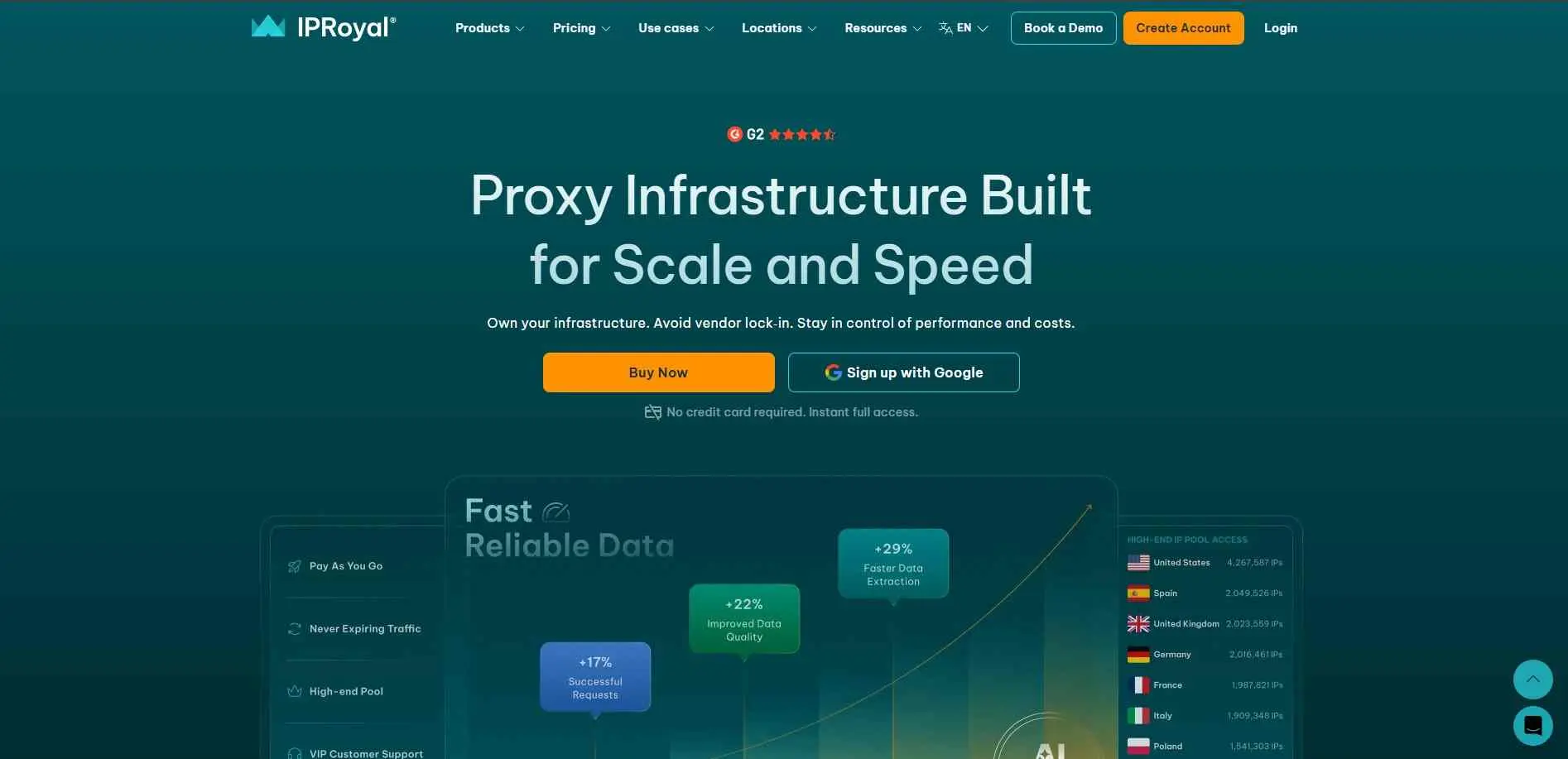
IPRoyal is headquartered in Ajman, United Arab Emirates, and its homepage lists TechRadar, PCMag and CNBC under “as seen on.” It sits between budget and enterprise. Traffic doesn’t expire, it enforces a strict KYC policy, and teams get workspaces with roles and two-factor login. It also lists 650+ supported integrations. The KYC step can slow signup, which is the price of its compliance focus.
Key features
- Residential from $1.75/GB with a 64M+ pool, ISP from $1.80 per proxy, datacenter from $1.39
- City and state targeting across residential, ISP and datacenter proxies
- Web Unblocker from $1.00 per 1,000 requests for automated block handling
Best for
Companies that need access controls and invoicing more than the lowest price.
6. SOAX
SOAX is a UK company based in Uxbridge, near London, and says more than 5,000 product teams use it, from startups to large enterprises. It sells only residential and mobile IPs, and its selling point is control. You get to choose when an IP address changes and when it stays the same as going with a fixed option. They claim 99.9% uptime and gives prices for small businesses. Its list of 12 million or more IP addresses over 30 days is much smaller than the largest networks so check how well it works in the countries you need.
Key features
- Rotation rules by request, request count, time or error, or locked to one node
- City, state and ASN targeting in 195+ locations over HTTP, HTTPS and SOCKS5
- A free sandbox account, credits at $1 each, and managed scraping services
Best for
Scrapers who want to tune session and rotation behavior themselves. We didn’t see its pricing page, so check current rates.
7. Bright Data
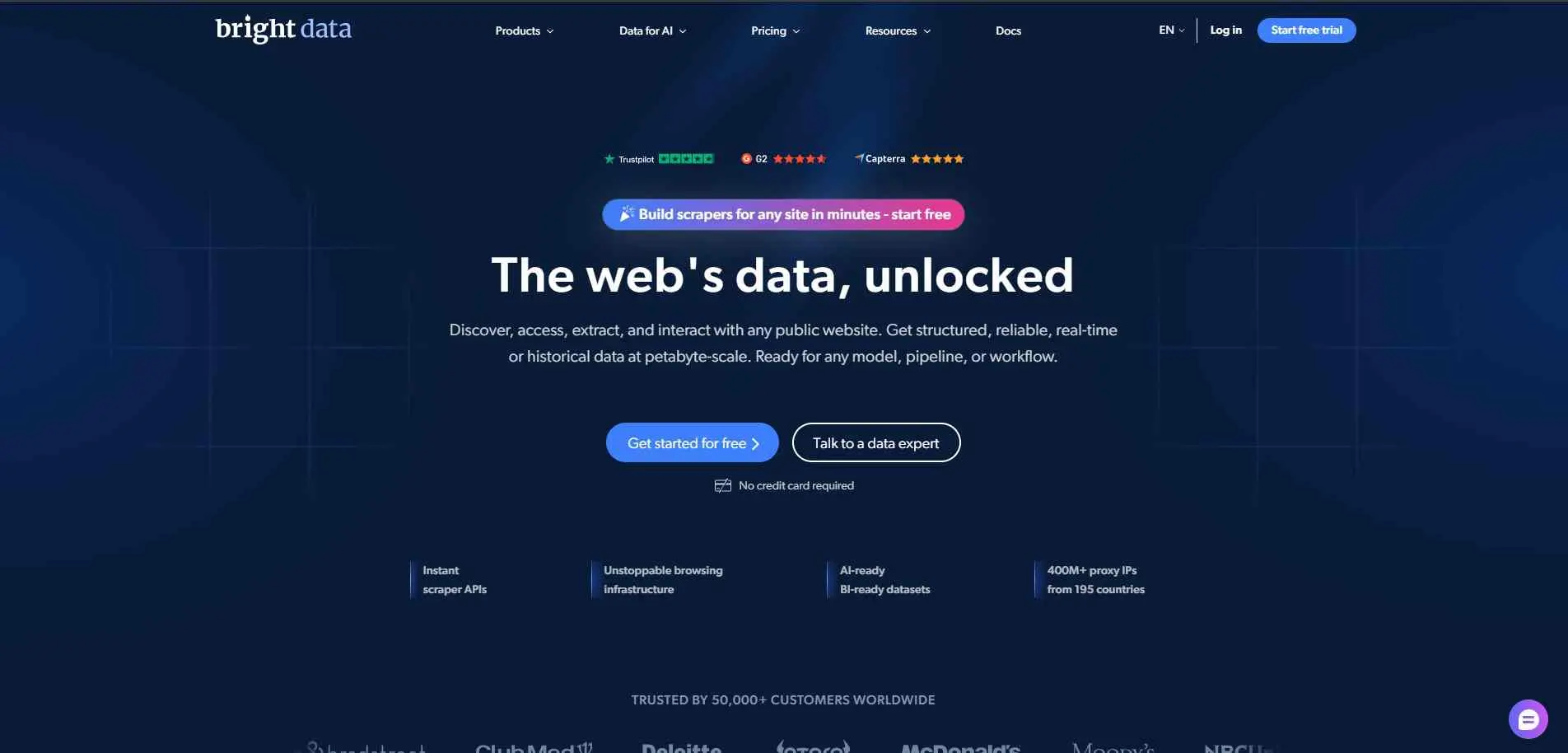
Bright Data is the enterprise end of the market. It used to be called Luminati. It has offices in San Francisco, New York and Netanya, Israel, and says 50,000+ organizations use it. It claims 400M+ residential IPs, and around that network it sells unblocking APIs, remote browsers, ready-made scrapers and datasets. It also runs a pro bono program, the Bright Initiative, which works with nonprofits, universities and public bodies.
Key features
- Residential from $2.50/GB during a 50% promotion (listed at $5)
- Unlocker, SERP, Browser and Crawl APIs, plus Scraper APIs covering 1,200+ sites
- Datasets from 900+ domains and a free MCP server for AI agents
Best for
Enterprises and AI teams that want proxies, APIs and data under one contract. Managed data services start at $1,500 a month, which is more than most solo projects need.
8. ScrapingAnt
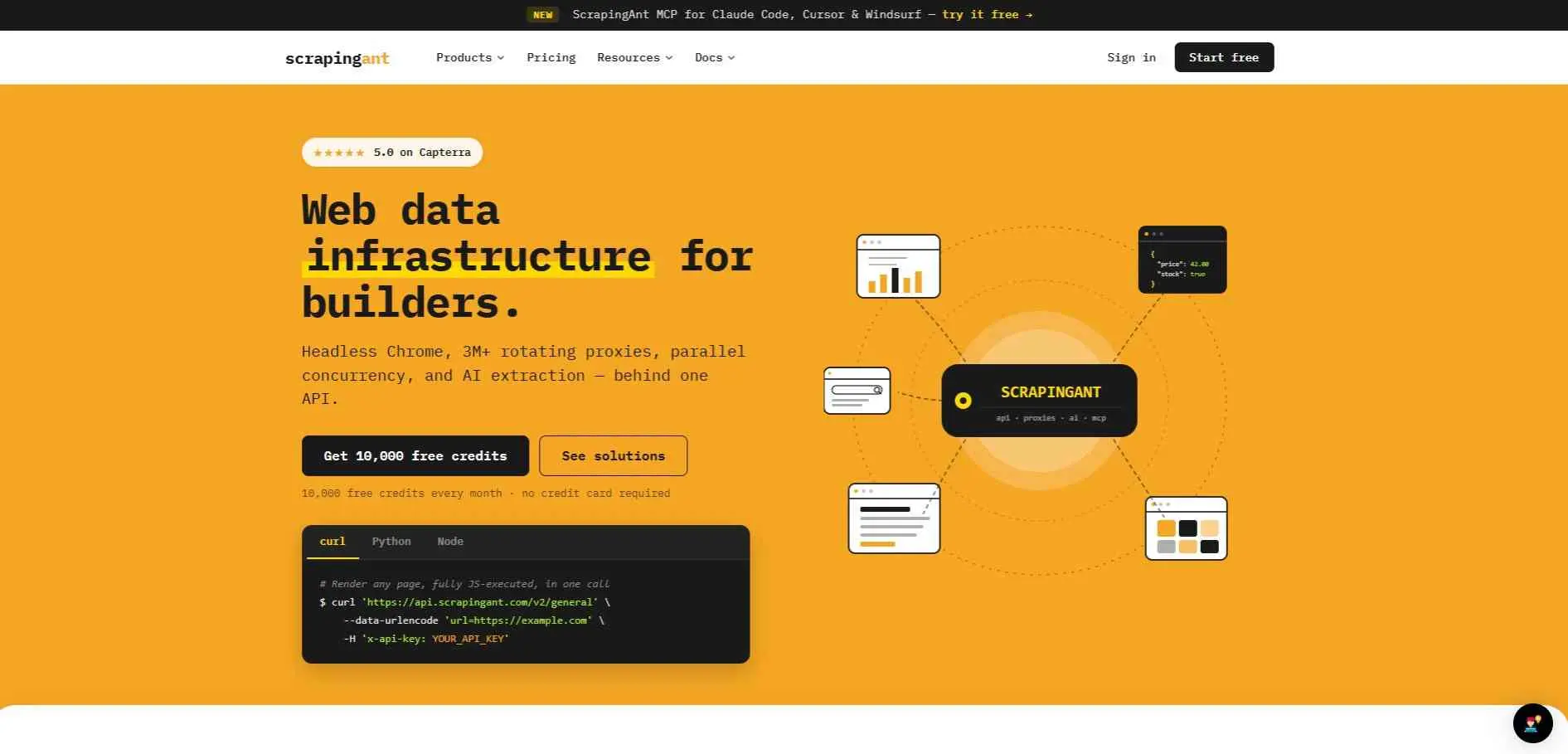
ScrapingAnt’s site names founder Oleg Kulyk and shows a 5.0 rating on Capterra. It’s mainly a scraping API: send a URL, get the rendered page back. It also sells standalone proxies by the gigabyte, and it builds custom scraping projects for clients who’d rather buy than build. A default request with Chrome rendering costs 10 credits, so 100,000 credits cover roughly 10,000 pages.
Key features
- 10,000 free credits every month with no card, and paid plans from $19 for 100,000
- Headless Chrome with 3M+ rotating proxies, and plain-English extraction into JSON
- Failed requests cost nothing, and a hosted MCP server works in Claude Code and Cursor
Best for
Solo developers who want one endpoint and a free tier that renews. Its 3M+ proxy pool is small next to the networks above.
9. Scrapfly
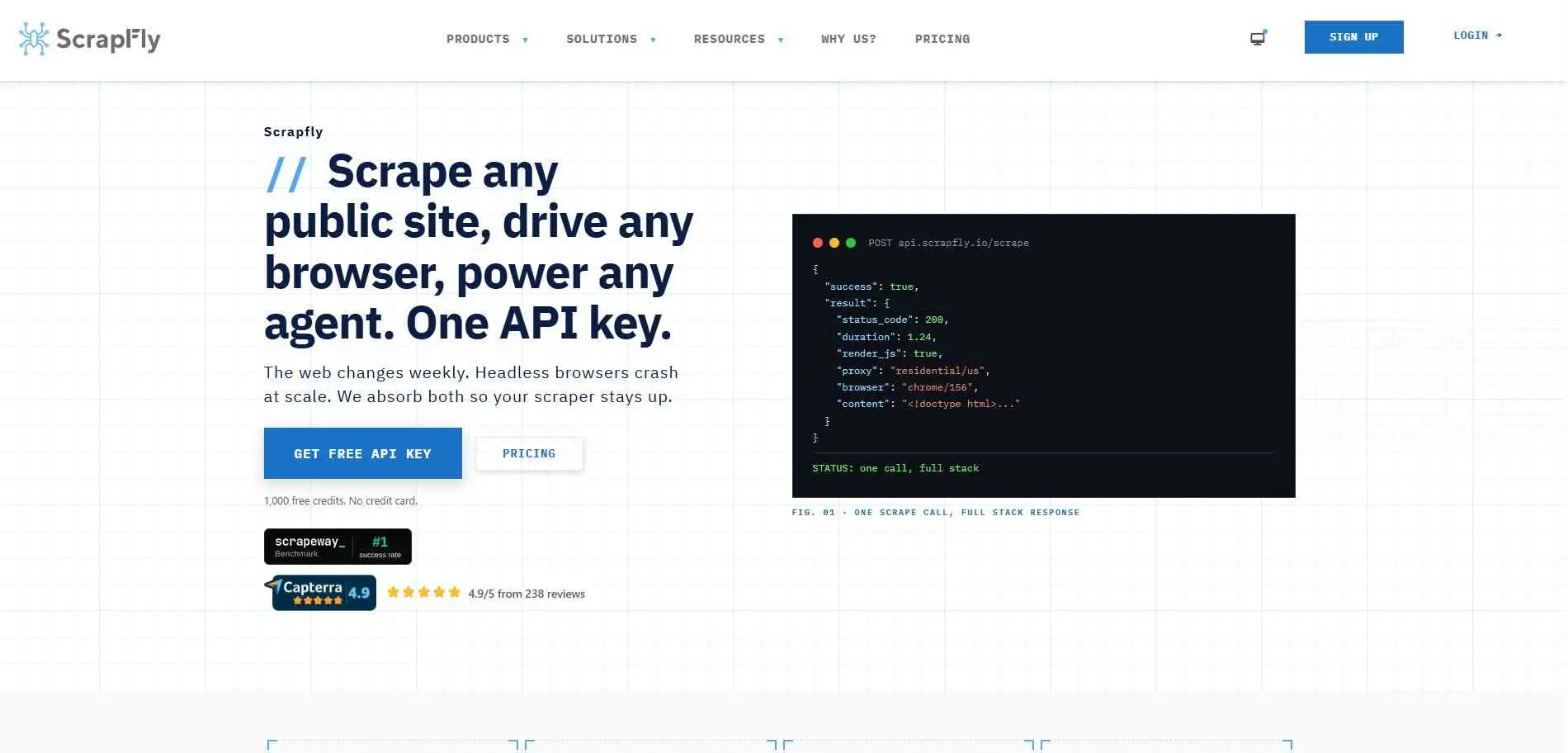
Scrapfly builds most of its own stack, including a proprietary HTTP engine called Curlium and a managed Chromium called Scrapium. It says 30,000+ enterprises use it and that it handles 15B+ requests a month, and it shows a 4.9 rating from 238 Capterra reviews. It also publishes open-source scrapers on GitHub and a free Web Scraping Academy. It’s an API company that lets you bring your own proxies. Its Proxy Saver wraps providers such as Bright Data, Webshare or DataImpulse to trim bandwidth. Pricing is credit-based, and residential requests cost 25 credits each.
Key features
- A Cloud Browser API: managed Chromium over CDP that works with Playwright and Puppeteer
- Free failed requests, plans from $30 for 200,000 credits, and 1,000 free credits to try
- Compliance certificates including SOC 2 Type II and ISO 27001
Best for
Teams already running Playwright against protected sites. Its 98% success figure comes from a third-party benchmark the company highlights, so run your own test.
10. Scrapingdog
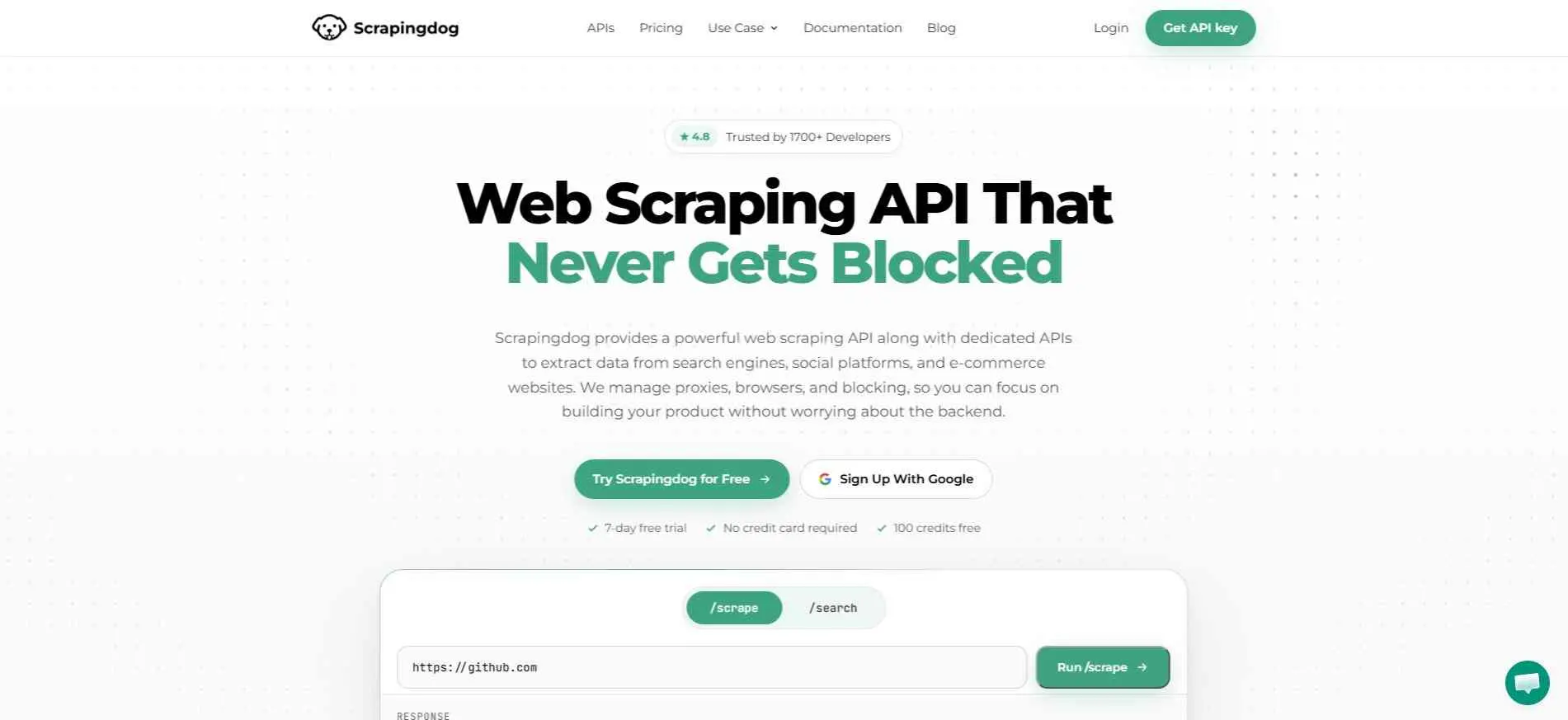
Scrapingdog is made by OpenData Labs and led by co-founders Manthan Koolwal (CEO) and Darshan Khandelwal (CTO). It says 1,700+ developers and companies use it, and it recently added an enrichment API for emails and company data. It’s built around ready-made endpoints. Instead of raw HTML you get parsed JSON from dedicated APIs, and one account covers all of them. Credit cost varies by endpoint.
Key features
- 80+ dedicated APIs returning parsed JSON, such as Google SERP at 5 credits and Amazon at 1
- 40M+ rotating proxies with headless Chrome and automatic CAPTCHA solving
- 100 free credits, then $40 a month for 200,000, with only successful requests charged
Best for
SEO tools and price trackers that want JSON instead of HTML. The free tier covers little more than a quick test.
Quick Comparison
Tool | Type | Starting price | Free option | Watch for |
| Roundproxies | Network | See pricing page | No-card signup | Conflicting pool sizes |
| Decodo | Network + API | $2/GB | 3-day trial | Use decodo.com only |
| Webshare | Network | $2.99/mo | 10 free proxies | Small entry plans |
| DataImpulse | Network | $1/GB | None | Extra fee for city targeting |
| IPRoyal | Network | $1.75/GB | None listed | KYC can slow signup |
| SOAX | Network | Credits at $1 | Free sandbox | Smaller IP pool |
| Bright Data | Network + API | $2.50/GB promo | Free trial | Cost at scale |
| ScrapingAnt | API | $19/mo | 10K credits monthly | Small proxy pool |
| Scrapfly | API | $30/mo | 1,000 credits | Residential costs 25 credits |
| Scrapingdog | API | $40/mo | 100 credits | Tiny free tier |
Which One Should You Pick?
Want cheap residential traffic with no subscription? DataImpulse or IPRoyal. Starting free? Webshare, or ScrapingAnt’s monthly credits. Need to control rotation yourself? SOAX. Want JSON from Google or Amazon without writing parsers? Scrapingdog. Don’t want to write code at all? A visual scraper like Octoparse covers simple extraction jobs without a script.
Running Playwright against a hard target? Scrapfly. Planning to grow into APIs without changing vendor? Decodo. Buying for a large team or AI pipeline? Bright Data. Just want to test several proxy types fast? Roundproxies.
Before You Pay
Run the same 500 URLs through two or three providers and compare success rate, cost per successful page and median response time. Success rates on a vendor’s homepage are averages across everyone’s targets, not yours. Then read the sourcing and KYC pages, since how residential IPs are sourced is an ethical question as well as a technical one. Finally, check whether unused traffic expires. DataImpulse and IPRoyal say theirs doesn’t.
Final Verdict
There’s no single winner, and the list shouldn’t read like one. DataImpulse has the lowest listed residential rate at $1/GB, with IPRoyal close behind at $1.75. Webshare is the easiest place to start for free. Decodo and Bright Data cover the widest ground, at very different budgets. ScrapingAnt, Scrapfly and Scrapingdog are scraping services more than proxy providers, so pick them when you’d rather not run browsers and rotation yourself. If you remember one thing, remember the units: gigabytes, IPs and credits aren’t the same. Prices change often, so confirm each one before you buy.