

 Table of Content
Sending out forty job applications in a weekend used to mark someone as desperate. Now it barely keeps pace. The average corporate job opening now draws around 240 applications, and any single one has roughly a 0.4% chance of turning into the job, so applying widely isn't optional anymore. The catch is that volume and quality pull in opposite directions.
Hand-tailoring a resume and cover letter for one role takes 30 to 60 minutes, which caps most people at a handful of real applications a day. AI job search tools exist to break that ceiling, and over the past two years they've become the standard way serious applicants keep up.
In this post you'll learn which AI job search tools genuinely improve day-to-day productivity, starting with a detailed look at AIApply and how its auto-tailoring and bulk submission work in practice. After that we cover three other tools worth knowing, how to judge which one fits your search, and what to watch for before you hand any of them your job hunt.
The 2026 Reality: Why "Mass Applying" is Dead
In the mid-2020s, tools focused on "spray and pray" automation. They promised that applying to 1,000 jobs a day would solve your problems. In 2026, that strategy failed. Platforms like LinkedIn, Indeed, and specialized tech boards now employ “Automation Fingerprinting” to bypass ATS (Applicant Tracking Systems).
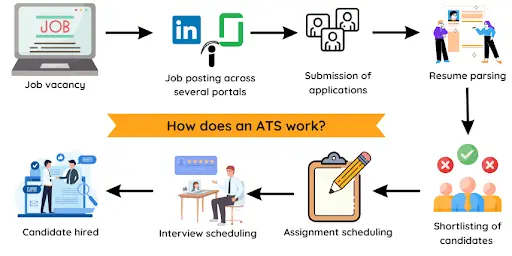
If an application is submitted with zero "human-like" dwell time on the page or lacks hyper-specific customization that reflects the company’s recent news or culture, it is flagged as spam. The winning strategy today is Full-funnel Augmented Application: Using AI to handle 95% of the heavy lifting (writing, formatting, tracking) while you provide the final 5% of critical editing.
To build a high-conversion "Application Stack," you need a suite of tools that specialize in different parts of the funnel.
AI job search: auto-tailored resumes, cover letters, and applications at scale
AI job assist tools are built around a single idea, which is to take the parts of the application that eat the most time and do them at volume.
- Paste in a job posting or use the built-in job search, and it generates a resume and cover letter rewritten for that specific role, pulling language straight from the description
- The output stands a better chance against the applicant tracking systems that nearly 98% of Fortune 500 companies now use to filter applications
- Instead of one carefully hand-edited application, you can produce dozens that are each shaped to their posting.
The honest trade-off is that automation at this scale rewards people who already know what they want. If your target roles are well defined and you're applying to many similar positions, AI tools turn a full day of manual work into an hour of review.
If you're still figuring out your direction, or chasing a small number of senior roles where every application should be handcrafted, the volume features matter less and you're paying for capacity you won't use. It fits career changers, recent graduates, and anyone running a genuinely high-volume search best.
1. Aiapply
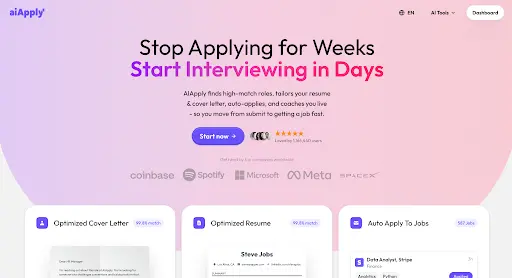
The feature that separates Aiapply from most resume builders is auto-apply. Its browser extension and application agent fill in and submit applications for you across job boards, so the bottleneck moves from your typing speed to your judgment about which roles are worth targeting.
Around that core, AIApply adds an interview assistant that drafts likely questions and suggested answers, a follow-up email writer, and support for applying in several languages, which matters if you're searching across countries. It's free to start, with paid plans covering the full auto-apply volume.
2. Teal HQ
Teal works less like an application cannon and more like a control room for your search. Its Chrome extension saves postings from LinkedIn, Indeed, and company career pages into one tracker, and its resume builder scores how well a given resume matches a job description by comparing keywords. Teal doesn't submit applications for you, which is the point for people who want tighter control over each one. The core tracker is free, with the matching and AI writing features sitting behind Teal+.
3. JobRight.ai
JobRight leads with matching. It scores how well each posting fits your background, tailors your resume to the ones you choose, and its AI agent can auto-fill and submit applications, putting it closer to AIApply on the automation scale. A useful extra is that it surfaces people already in your network at a target company, so a cold application can become a warm introduction. It runs a free tier with paid plans for heavier automation.
4. Kickresume
Kickresume sits at the opposite end from auto-apply, focused on producing one polished resume and cover letter rather than a hundred quick ones. It pairs a large template library with an AI writer that drafts and rewrites sections. Its own data is a useful signal about how people actually use these tools: of the 1.2 million job seekers who used its AI features in 2025, the most common task was checking a resume for ATS compatibility, not writing one from scratch. Kickresume is free to start, with paid plans for premium templates and exports.
How to choose the right AI job search tool
The tools above split along one clean line, which is how much of the work they take off your hands. Auto-apply tools like AIApply and JobRight optimize for throughput, while trackers and builders like Teal and Kickresume optimize for the quality of each application. Before committing, weigh four things:
- How much it automates, from finding roles to actually hitting submit, and whether you want that much taken out of your hands
- Whether its tailoring reads like you wrote it or like a template, since recruiters increasingly catch generic AI output
- What it costs measured against how many applications you realistically send, not the sticker price on its own
- Which stage of the search it helps, whether that's discovery, writing, submitting, or interview prep
The productivity gain is real but conditional. A high-volume search with clear targets gets the most from full automation, while a focused senior search often does better with a tracker and a hand-tuned resume. Match the tool to your search rather than to whichever one has the longest feature list.
Key takeaways
- Applying at volume is now table stakes, so the tools worth using are the ones that keep quality from collapsing as you scale up.
- AIApply is the most automation-heavy option here, generating tailored resumes and cover letters per posting and submitting applications for you, which fits high-volume searches with well-defined targets.
- Teal and Kickresume favor quality over quantity, one keeping your search organized, the other producing a single polished resume.
- JobRight sits in the middle, combining match scoring and auto-apply with warm-introduction features.
- Automation only pays off when your targets are clear, since a focused senior search still rewards a hand-tuned application.
- Judge any tool on tailoring quality, cost against the number of applications you actually send, and which stage of the search it helps, not on feature count.